On the morning of September 27, 2025, the Department of Big Data Management and Science of the School of Economics and Management held the Student-Faculty Meeting and Academic Advisor Matching Session for the 2024 Cohort of the Big Data Management and Application Program in Room B117. Attending the meeting were Professor Jiang Hongyan, Vice Dean of the School of Economics and Management; faculty members Wang Huaqing, Wang Bangjun, Gan Dali, Wang Di, Liu Feng, Nie Ruxin, and Guo Huijing; all students of the 2024 cohort of the Big Data Management and Application program; as well as prospective transfer students. The meeting was chaired by Professor Wang Huaqing, Head of the Department of Big Data Management and Science.
Professor Wang noted that since the beginning of the 21st century, the rapid advancement of science and technology—particularly the integration of artificial intelligence and big data—has become a key driver of social progress. To meet this trend, the School established the Big Data Management and Application program in 2020, aiming to cultivate professionals who apply modern science and technology in management practice to enhance efficiency and foster innovation.
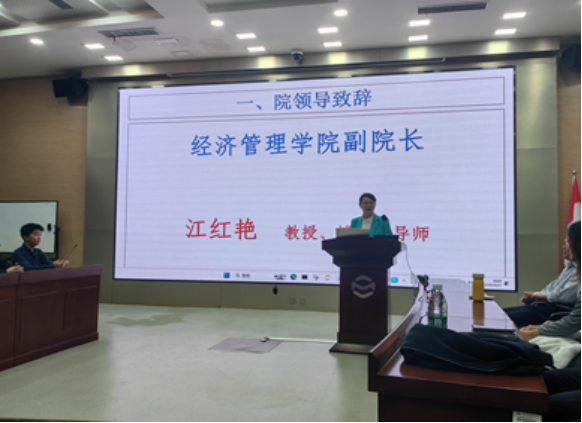
Vice Dean Jiang Hongyan, on behalf of the School leadership, delivered an opening speech filled with expectations and advice for the new students. She warmly welcomed all new members of the program, remarking that they represent not only the future of the School of Economics and Management but also the future of the digital economy. Professor Jiang emphasized that the student-faculty meeting and advisor matching session held great importance. She explained that the Big Data Management and Application program was established in response to China’s national big data development strategy and is an interdisciplinary program integrating management, economics, and computer science. The goal, she said, is to nurture versatile talents with both data-driven thinking and business insight.
Professor Jiang encouraged students to strengthen their mathematical and statistical foundations, master solid programming skills, and actively develop data literacy and analytical thinking. She urged students to apply big data to areas such as fintech, healthcare, and e-commerce, and to clarify their career goals early—whether aspiring to become business executives, data scientists, or academic researchers. She encouraged them to engage actively in internships, competitions, and practical training, and concluded with an inspiring message:
“Let data be your melody and algorithms your companions. May you use the brush of data science to paint the vibrant canvas of your university life and witness your own growth and transformation.”
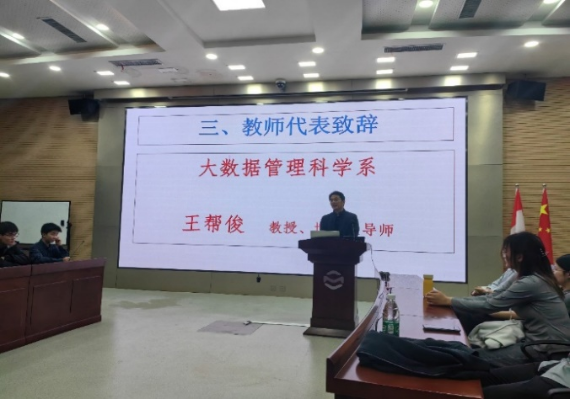
Professors Wang Bangjun and Wang Di, speaking as faculty representatives, noted that the era of intelligent data brings both opportunities and challenges. They emphasized that the Big Data Management and Application program, which tightly integrates computer science and management science, requires strong interdisciplinary competence. They encouraged students to build firm foundations in management theory—mastering subjects such as management science, operations research, statistics, and systems science—and to acquire digital and computational thinking skills. They also highlighted the importance of learning data mining, modeling, artificial intelligence, and system architecture to fully develop big data analytical capabilities. Furthermore, they stressed the significance of research experience, advising students to actively participate in faculty research, competitions, and training projects to cultivate analytical and problem-solving abilities.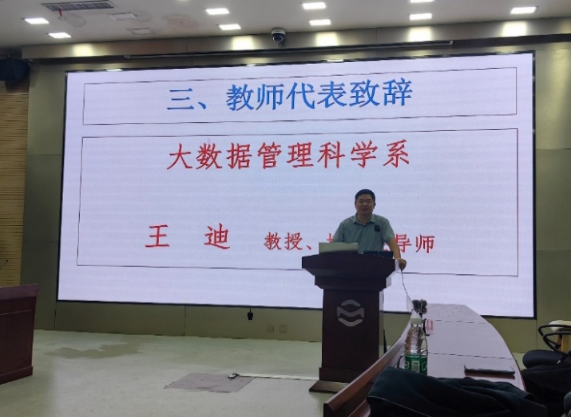 Professor Wang Huaqing introduced the faculty team of the Department and reviewed the program’s achievements, noting that the Big Data Management and Application program consistently ranks in the top 5% nationally according to the Shanghai Ranking. He attributed this success to the comprehensive guidance of School leadership, the dedication of all faculty members, and the hard work of students.
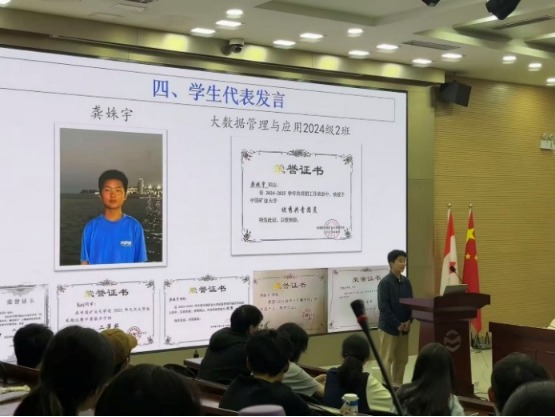
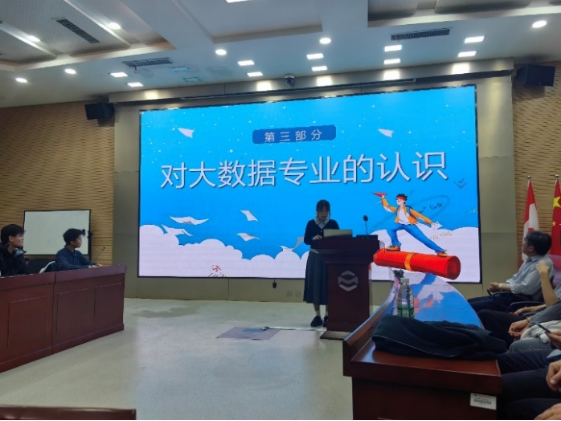
Student representatives Gong Shuyu (Class 2) and Yin Luyao (Class 1) shared their experiences. Gong expressed deep gratitude for the faculty’s rigorous academic attitude and patient guidance, urging peers to build solid foundations in management, economics, and computer science while maintaining curiosity for emerging technologies like AI and data mining. Yin described her journey of transferring into the program and her growing fascination with solving real-world problems through data. She encouraged fellow students to stay goal-oriented, overcome challenges with confidence, and focus on using data to create value for businesses and society.
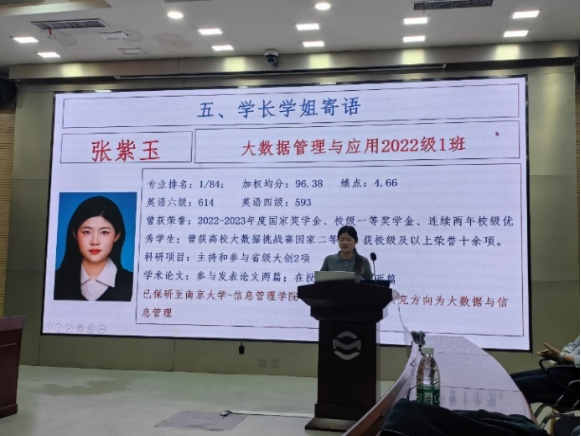
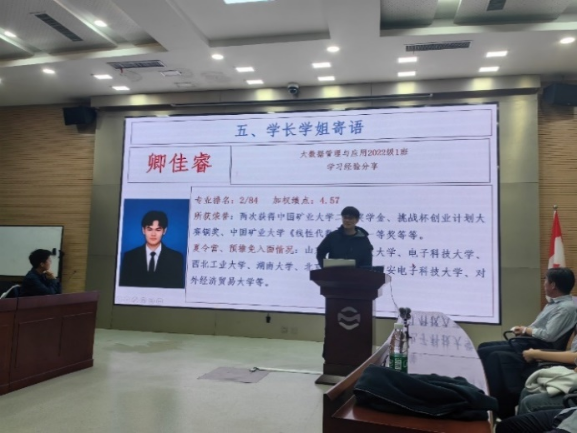
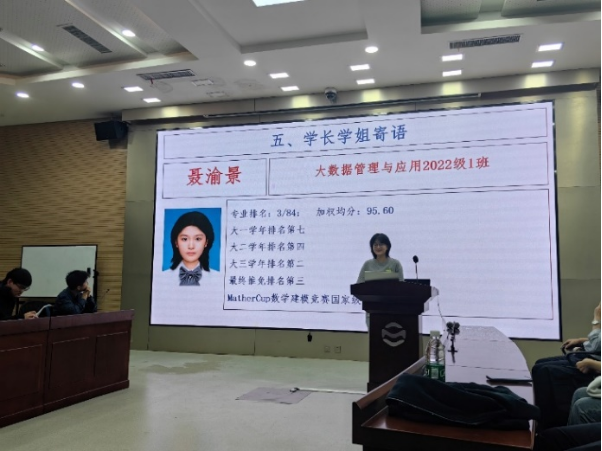
Senior students Zhang Ziyu (recommended for admission to Nanjing University), Qing Jiarui (recommended to Northwestern Polytechnical University), and Nie Yujing (recommended to Dalian University of Technology) offered their advice as graduating representatives. Drawing from their experiences in research and competitions, they suggested that students enhance their competitiveness for graduate school through research projects, academic papers, coding skills, and strong English proficiency. They reminded juniors that university is a time for exploration and self-discovery, encouraging them to find their passion and pursue their dreams courageously.
Professor Wang Huaqing concluded by reminding students that the purpose of the meeting was not only to convene but also to ignite a sense of responsibility and mission.
“Big data is not merely a collection of technologies,” he said. “It is the core of national competitiveness, a tool for social governance, and an engine of business innovation. You are the participants, drivers, and even the future leaders of this transformation.”
He elaborated on the goals and significance of the academic advisor system, invited all faculty members to introduce their research areas and future courses, and encouraged students to actively engage in faculty research, cultivate innovation, and aspire to become pioneers in the field of big data management.
In closing, Professor Wang shared an inspiring message:
“You are not just students of big data — you are the people who will change the world with big data. Believe in yourselves and your future, and you will realize your youthful dreams and achieve brilliance in life.”
photography: Guo Huijing
Written by: Nie Ruxin
First Review: Wang Huaqing
Second Review: Jiang Hongyan
Third Review: Li Xinchun